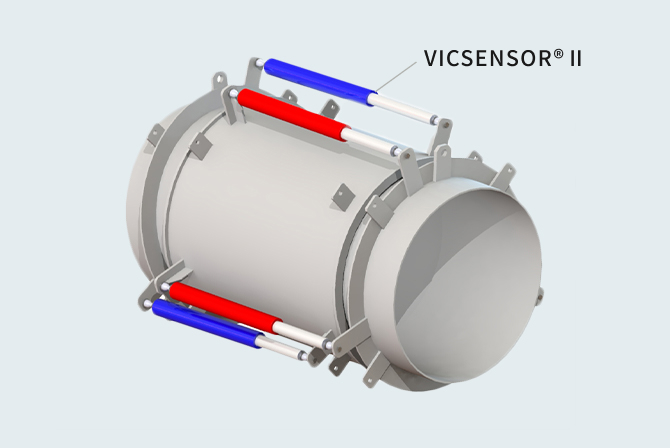
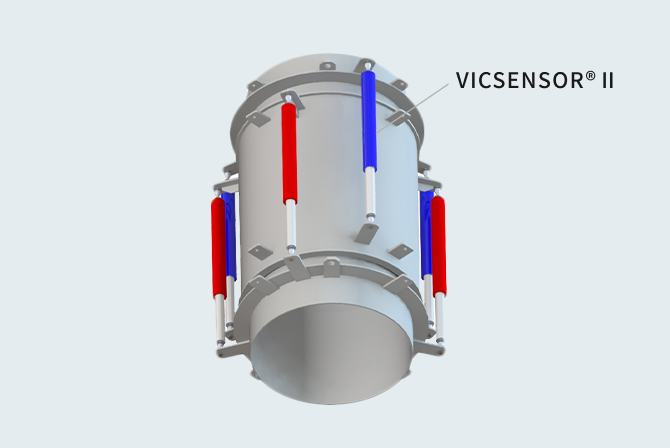
A monitoring system that enables remote monitoring of displacement conditions in expansion joints installed in underground pipelines and hard-to-access piping systems.

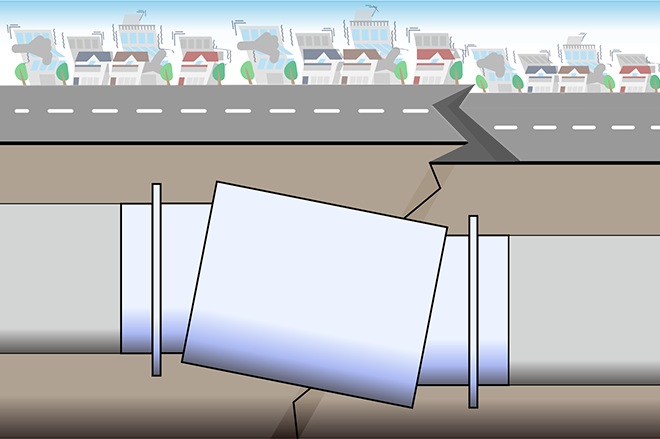
Following the Great East Japan Earthquake in March 2011, significant displacement occurred in many pipeline systems, and numerous joints exceeded their allowable displacement limits.

In response to customer requests for a solution that could monitor the displacement of buried joints without excavation in preparation for future earthquakes, the VIC Sensor II was developed.

By installing sensors on joints in underground and overhead piping systems where on-site inspection is difficult, the system enables displacement monitoring and supports rapid repairs as well as future maintenance planning.

  • NETIS (New Technology Information System), MLIT Registration No. KK-170004-A
  • Recipient of the Excellence Award, 1st Infrastructure Maintenance Award
  • Featured in Aqua-LIST (Collection of New Technology Case Studies for Water Supply), Japan Water Research Center (JWRC), Case No. 23-004

Product Features

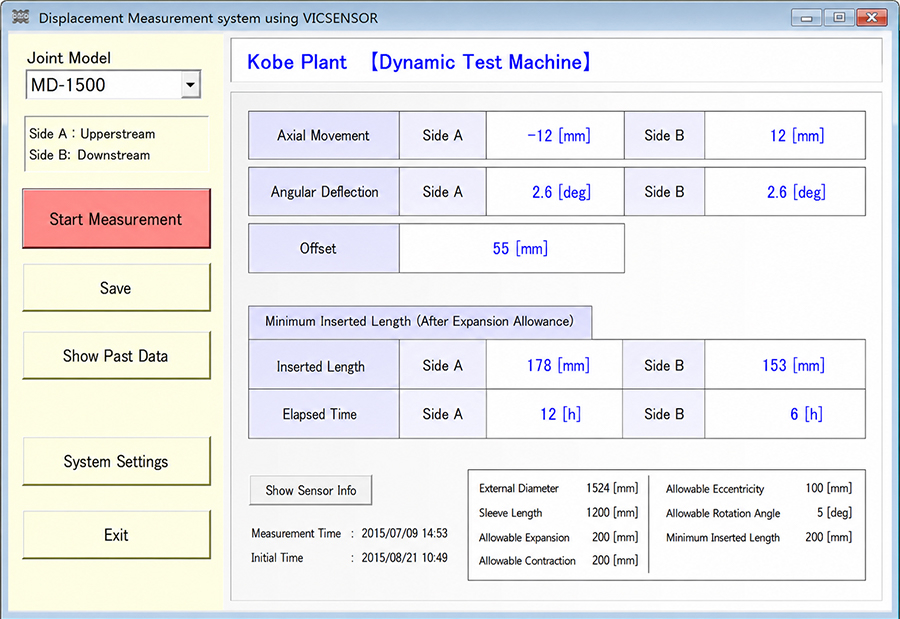
Sensors installed on the joints track joint displacement and measure displacement conditions in real time.

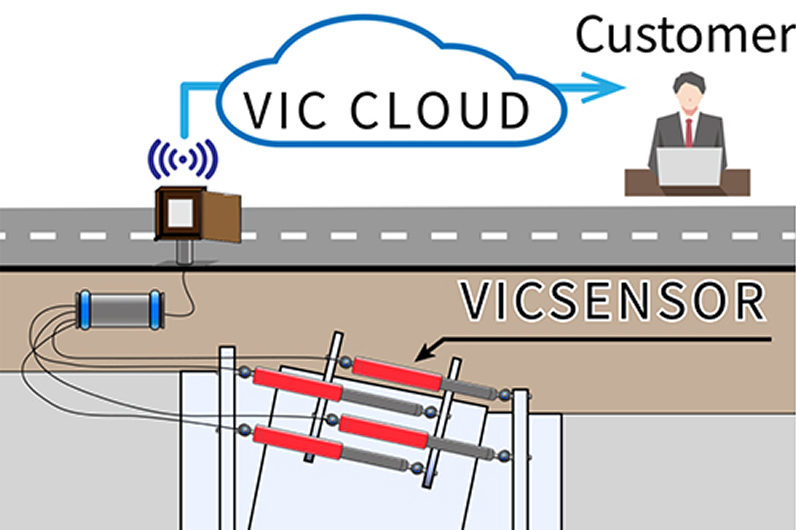
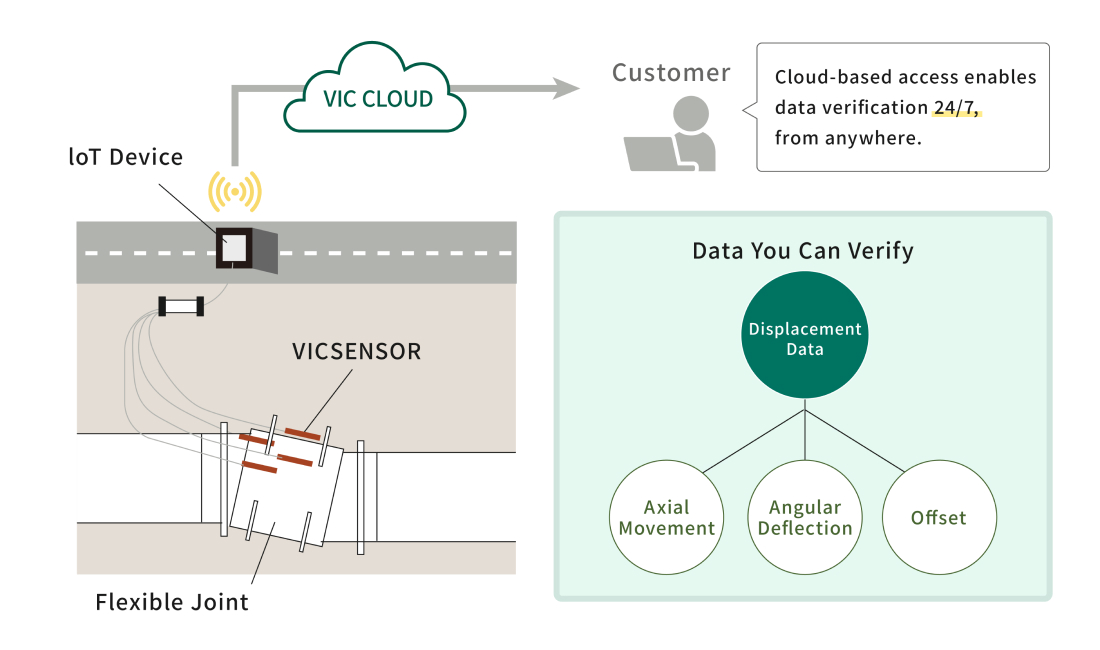
Measured data is recorded in a data logger connected to the sensors. Users can either connect a dedicated measurement unit to the data logger on site to review the data, or remotely access the cloud from their own devices to monitor measurement results.

View Product Information

Applications

  • Pipelines located beneath major roadways and other areas where excavation is difficult

  • Pipelines installed in soft ground conditions where predicting joint displacement is difficult

  • Pipelines in overhead or hard-to-access locations where on-site inspection is difficult

Solving These Challenges

  • Challenges

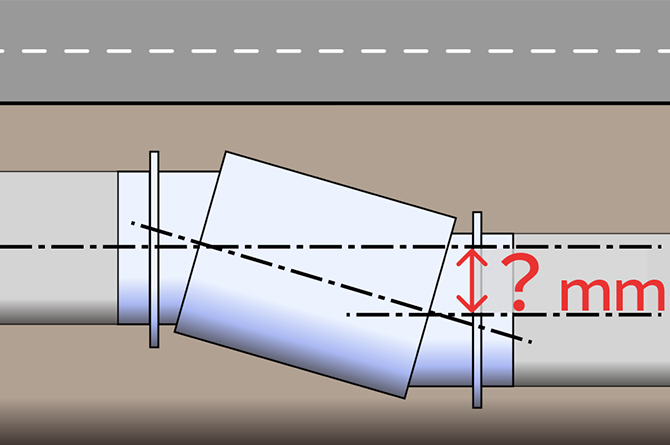
    Concerned about joint displacement conditions after an earthquake

    Solutions

    Joint displacement conditions can be monitored remotely without conducting on-site inspections

  • Challenges

    Unable to determine the appropriate timing for reinforcement due to unknown joint displacement conditions

    Solutions

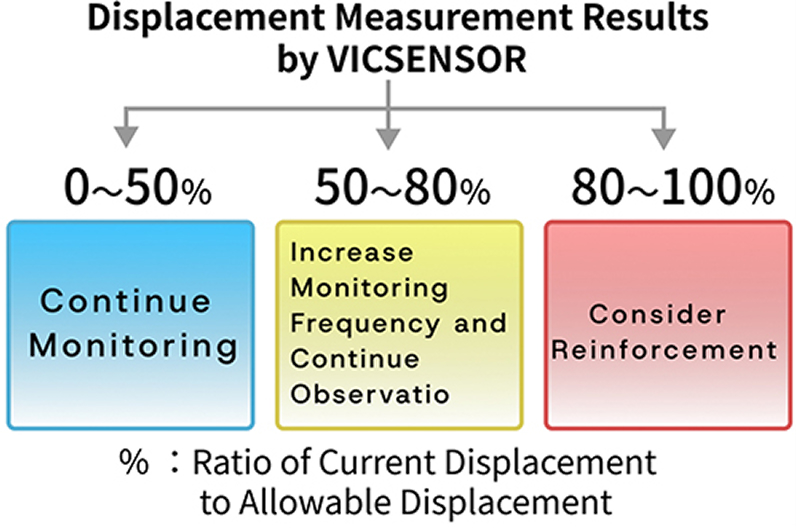
    Optimal reinforcement timing can be planned based on measured displacement values and allowable displacement limits

  • Challenges

    Frequent excavation for inspection of buried pipeline joints is difficult

    Solutions

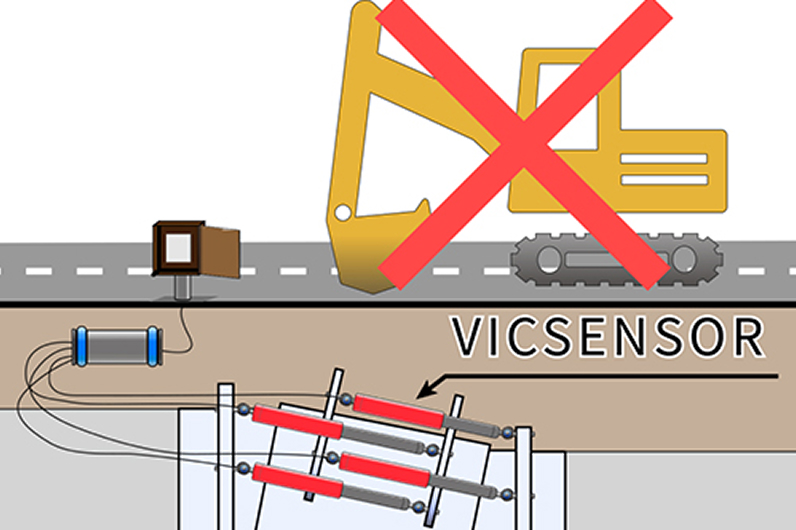
    Displacement can be monitored without excavation

VicSensor II enables remote monitoring of joint displacement conditions without the need for on-site inspections.

How Visualization Works

  1. Sensors installed on the joints detect displacement
  2. A ground-level data logger automatically records measurements at regular intervals
  3. IoT devices transmit measurement data to the cloud
  4. Users can access and monitor data anytime from their own devices
Delivery Record Several dozen installations from 2016 (year of development) to 2022
Main Installation Sites Water supply facilities, agricultural water facilities, airport facilities, and more

Why Choose Our Solution

  1. 01.Eliminates the time and cost required for excavation

    Even in locations where excavation would normally be required, displacement conditions can be monitored without excavation by installing sensors on the joints and measuring from ground level.

  2. 02.Facilitates maintenance planning

    By understanding current displacement conditions, users can plan future replacement, reinforcement, and maintenance work based on long-term displacement trends.

  3. 03.Cloud-based monitoring enables data access anytime

    IoT devices transmit measurement data to the cloud.

    Users can access and monitor data anytime, 24 hours a day, from their own devices such as PCs and tablets.

Case Studies

  • Before

    In soft ground conditions, joint displacement may exceed allowable limits in a short period of time

    After

    Enables continuous monitoring of flexible joint displacement conditions

    More

    Visualizing joint displacement in soft ground and buried pipeline systems

    Water authorities

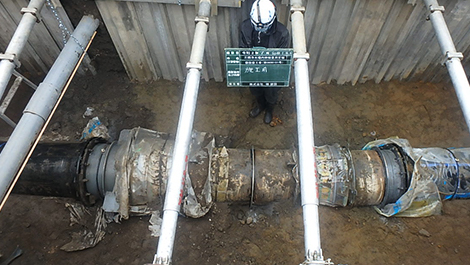
    Installation Target Buried pipeline at a water treatment plant / Flexible joint, 600A diameter
    Reason Due to soft ground conditions, rapid reinforcement planning is required when flexible joint displacement exceeds allowable limits
Close

Visualizing joint displacement in soft ground and buried pipeline systems

Water authorities

Installation Target Buried pipeline at a water treatment plant / Flexible joint, 600A diameter
Reason Due to soft ground conditions, rapid reinforcement planning is required when flexible joint displacement exceeds allowable limits

Implementation Flow

  1. 01

    1 day

    Investigation

    Investigation of existing joint dimensions, displacement conditions, and surrounding structures

  2. 02

    10–20 days

    Product Design

    Custom design tailored to the shape of the existing joint

  3. 03

    80-100 days

    Product Manufacturing

    Handcrafted manufacturing of sensor mounting bands

  4. 04

    7days

    Product Installation

    Installation based on the current displacement condition of the joint

FAQ

  • qHow durable is the system?

    a

    The system is designed to have a service life comparable to that of the joint itself. The sensors used are based on the same technology used in dam water level monitoring systems with a proven track record of approximately 40 years.

  • qCan it be installed on existing joints?

    a

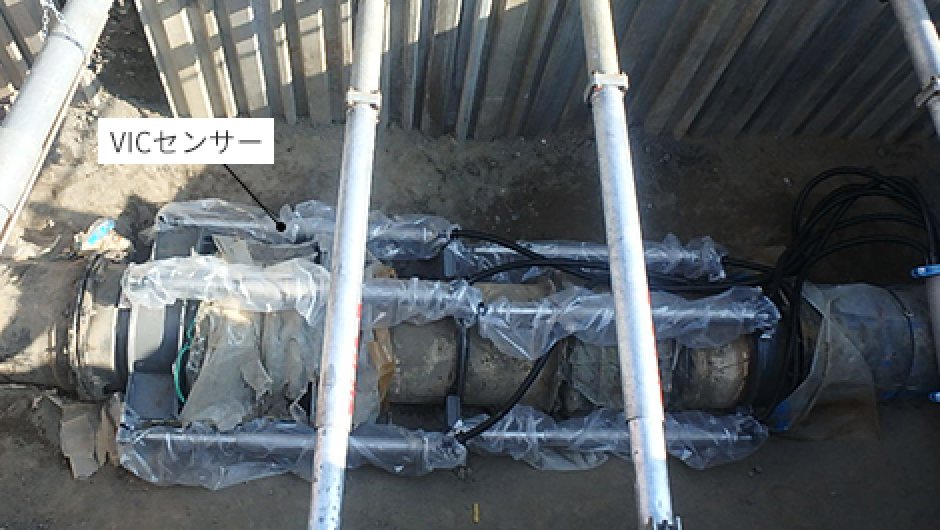
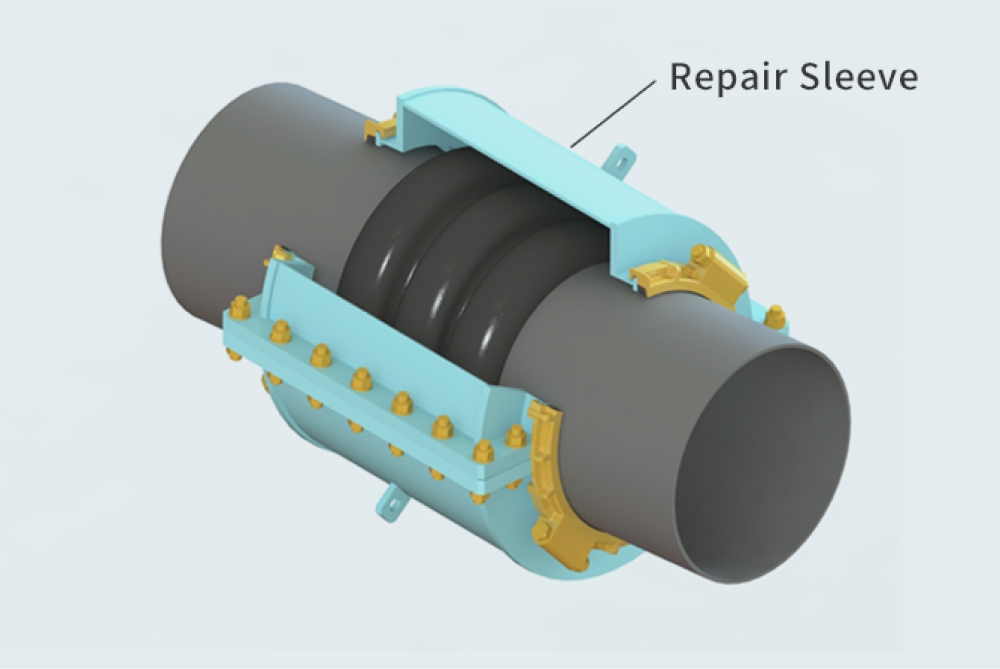
    Installation is possible on our joints. A sensor-mounted band is attached directly to the joint. For joints manufactured by other companies, a repair sleeve is first installed on the joint, and the sensor is then mounted on top of the sleeve.

  • qCan it be installed in buried pipelines?

    a

    Yes, installation in buried pipelines is possible. The sensor is equipped with a protective cover and designed to withstand underground installation environments.

  • qHow is the system powered

    a

    For cloud-based systems, commercial AC 100V power is used. For non-cloud configurations, the system operates on standard batteries.